February 16, 2026 by Clarissa Ayala
Building Smarter Access to Justice: An Update on Lone Star Legal Aid’s AI-Powered Chatbot Project
Lone Star Legal Aid is proud to share an update on our Legal Services Corporation Technology Initiative Grant (TIG) project, which supports the development of three AI-powered chatbots designed to strengthen access to justice and improve how legal aid information is delivered and managed.
Through this grant, our team is building:
- Navi, a public-facing chatbot designed to help individuals understand common civil legal issues and identify next steps;
- Juris, a legal research and knowledge-support tool developed with attorney-vetted content;
- LSLAsks, an internal chatbot that supports Legal Aid staff with administrative, HR, IT, and operational questions.
Together, these tools are part of Lone Star Legal Aid’s broader strategy to responsibly use technology to expand reach, reduce barriers, and better support both the public and our staff.
Sharing Our Work at the LSC Innovations in Technology Conference
In January, Ashley Oborn (Director of Data Analytics) and Sourav Mohan (Data Analyst) attended the LSC Innovations in Technology Conference, where they presented our work on the Technology Initiative Grant and early lessons learned from building and testing chatbots in a legal aid environment. We were honored to be invited to share insights alongside colleagues from other legal aid programs exploring the intersection of technology and access to justice.
“ITC 2026 exceeded all expectations. What struck me most wasn’t just the number of people who sought us out, but the caliber of conversations we had. From practitioners across the country to academic innovators, everyone wanted to understand how we’re approaching AI-powered legal solutions. We’re in discussions with leading institutions to test NAVI, and I am excited to join Stanford Legal Design Lab’s power group on knowledge bases for AI—a personal passion of mine that I’ve been pioneering for Texas. The conference recognized our expertise not just in our individual sessions, but by having our developer join expert panelists to host an advanced AI workshop on the final day. It confirmed we’re not just participating in the future of legal technology—we’re helping define it,” shared Oborn.
Our LSC TIG AI-Chatbots Project team delivered the following presentation:
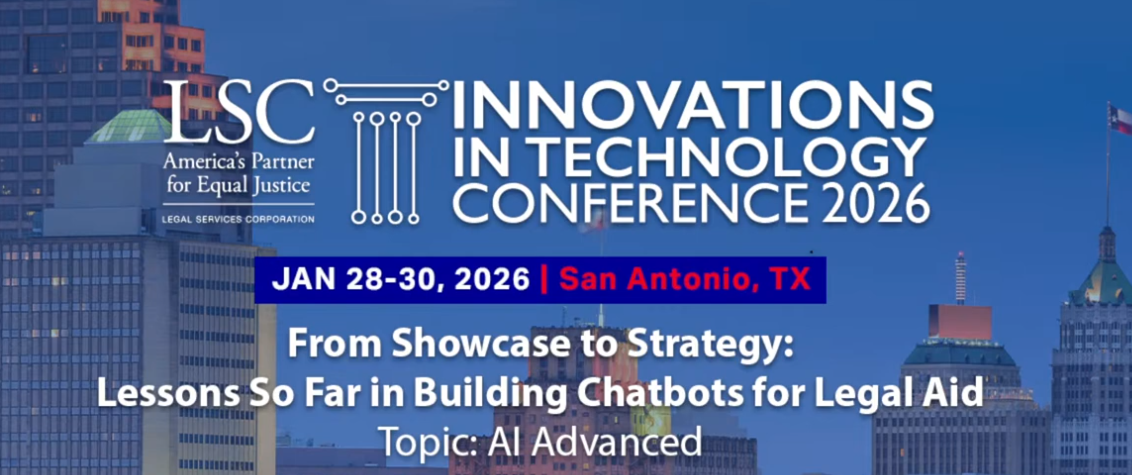
From Showcase to Strategy: Lessons So Far in Building Chatbots for Legal Aid
Legal aid organizations are exploring the use of AI-powered chatbots—but building one that actually works responsibly, accurately, and securely takes more than just good intentions. In this session, Ashley Oborn and Sourav Mohan shared real lessons learned from developing three chatbots at Lone Star Legal Aid: Juris (internal legal), LSLA Ask (internal admin support), and Navi (client-facing info and referral). Rather than a demo, this is a mid-journey strategy session focused on what we’ve learned so far: prompting techniques, the differences between internal vs. public-facing tools, incorporating memory and retrieval-augmented generation (RAG), and how to build smarter bots without increasing risk. Attendees left with actionable takeaways and practical guidance to jumpstart their own chatbot projects. In the final part of the session, we also explored what it takes to manage a project like this from within a legal aid organization. From cross-department coordination and internal user testing to milestone tracking and security planning, this segment offered a practical look at the non-technical work that’s essential to making chatbot development successful—and sustainable.
Watch the recording: https://www.youtube.com/live/hl2pfmoTObA?si=96Gv4w-l8BpdLaDE
We’re excited to share this resource so that other legal aid organizations, technologists, and access-to-justice advocates can benefit from our learnings and adapt these approaches in their own work.
Looking Ahead
As this TIG project continues, Lone Star Legal Aid remains focused on refining these tools, strengthening governance and accuracy safeguards, and ensuring that innovation remains grounded in equity, ethics, and client-centered design.
Our goal is simple but ambitious: use technology to help people get the right information at the right time and help legal aid staff do their work more efficiently and effectively.
We’re grateful to Legal Services Corporation for investing in innovation across the legal aid community and for creating opportunities like the Innovations in Technology Conference to share knowledge, challenges, and progress.